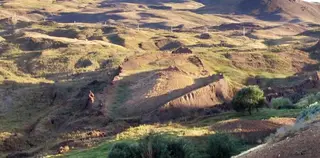
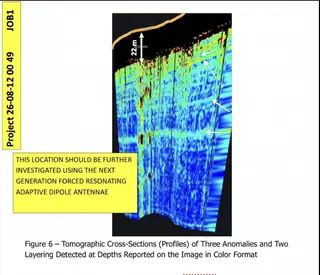
In a press release dated 27 October 2026, the US group Noah's Ark Scans said that radar results presented at a Noah's Ark Symposium in eastern Turkey show 'chambers and corridors' inside the boat-shaped Durupınar formation near Mount Ararat. Radar developer Khosrow Bakhtar said the features are 'not geologic', and Cenker Atila of Sivas Cumhuriyet University said the radar showed 'a formation with three levels'. The project also says charred wood was drilled from almost 30 feet down and sent for carbon-14 dating and species identification. Geologists have described the site as a natural rock formation since at least 1960. Published laboratory results and independent review of the full radar data would settle whether anything man-made lies inside; the university says evaluation will continue into 2027.
Project release: radar shows 'chambers, and corridors' and three levels; wood found almost 30 feet down
The release says Cenker Atila reviewed and confirmed preliminary scans by Khosrow Bakhtar, who said: 'It's not geologic related, because we masked all the geologic features.' Atila is quoted: 'in our radar studies, we also identified a formation with three levels.' The project also says the charred wood is 'not recent surface debris'. Its own founder, Andrew Jones, says the wood may equally be 'the charred remains of a shepherd's campfire', and the team says no firm conclusions should be drawn until laboratory results are published.
Follow-up release of 11 November: first photos of the recovered wood
According to the release's summary, the project published photos of darkened, cracked fragments with visible growth rings and said samples went to laboratories in four countries for radiocarbon dating and species identification. The project says no final conclusions have been drawn; the photos themselves cannot show where or how deep the wood lay.
A scholar of early Christianity: geologists agree the site is natural; the new results are preliminary
The article notes that a 1960 expedition 'revealed no sign that the object was man made', that geologist Murat Avcı explains the shape as a limestone block moved by a landslide and shaped by an earthflow, and that earlier 'petrified wood' and 'iron brackets' from the site turned out to be ordinary rock and weathered volcanic material. It says the newest results are 'still preliminary and inconclusive', while social media posts call the formation '100% not geological'.