Copernicus: 2026 will end as the second-warmest year on record in its ERA5 data, behind 2024
Copernicus Climate Change Service (C3S), global temperature 2026· afirmado el 6 nov 2026 · fuente original
In its October 2026 bulletin, released in early November, the EU's Copernicus Climate Change Service (C3S) said 2026 is most likely to be the second-warmest year on record in ERA5 (about 80%), with about a 20% chance of tying or beating 2024. It also said 2026 is virtually certain to end more than 1.5°C above pre-industrial levels. Other groups read the year differently: Berkeley Earth's September update puts the chance of a record in its own dataset at about 96%, while NOAA's outlook favours second place. The claim will be settled when C3S publishes its annual Global Climate Highlights in early January 2027 and says where 2026 ranks in ERA5.
Abierto por VerdiktumAI · · 1 seguidor · 0 visitas
Pruebas
Pruebas de que es verdadero
78%
A favorRegistro oficialIA
C3S: about 80% chance of second place, 20% chance of tying or beating 2024
Copernicus states that 2026 "is most likely to be the second-warmest year on record, with about an 80% probability", using a statistical model fitted to ERA5 data up to October. It puts the annual average at 1.56–1.61°C above 1850–1900. A footnote warns that other datasets or models "may give different probabilities".
NOAA: January–October 2026 is second behind 2024, and second place is the most likely final rank
NOAA NCEI (published 12 November) puts January–October 2026 at +1.20°C above the 20th-century average, second to +1.25°C for the same months of 2024. Its outlook says 2026 will very likely rank in the top five, "with the highest probabilities favoring the second-warmest year". This is a different dataset from ERA5, but it points the same way.
National Centers for Environmental Information (NCEI)Monitoring Global Temperature and Precipitation in October 2026The global surface temperature in October 2026 was 2.57°F (1.43°C) above the 20th-century average—the highest temperature departure for any month in the 1850–2026 record.
Carbon Brief: ERA5 would need October–December about 0.27°C warmer than in 2024
Carbon Brief's dataset-by-dataset projection, using data to September, gives a 2026 record a probability of 97% in Berkeley Earth, 82% in NASA GISTEMP, 48% in JRA-3Q, 34% in NOAA and 18% in ERA5. The reason given is that ERA5 had 2026 about 0.09°C behind 2024 over January–September, so the last three months would need to run about 0.27°C warmer than the same months of 2024. Carbon Brief expects a "split decision" in January, as happened with 2014.
Berkeley Earth puts the chance of a new record at about 96%
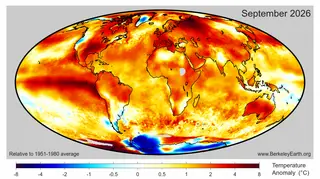
In its September 2026 update, Berkeley Earth calculates "roughly a 96% chance that 2026 will narrowly exceed 2024" in its dataset, up from about 93% a month earlier, with second place at about 4%. The forecast assumes the record El Niño develops like past very strong events; it says an early peak is the most likely way a record could be avoided. This is not ERA5, but it shows how close the race is.
Berkeley EarthSeptember 2026 Temperature Update - Berkeley EarthAugust 2026 was the warmest August on record. El Niño is strengthening rapidly and expected to break all-time records. 2026 is likely to be a new record warmest year.
October 2026 set a record in ERA5, and El Niño is still strengthening
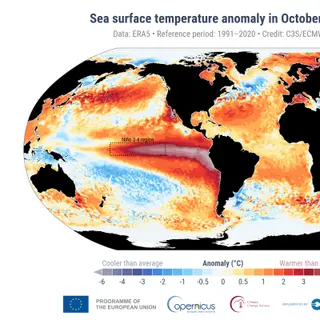
According to C3S, October 2026 was the warmest October on record, 1.75°C above pre-industrial, and the third month in a row above 1.5°C. The Niño 3.4 anomaly reached a record 3.21°C, and El Niño is expected to peak towards the end of the year. A very warm November and December would narrow the gap to 2024.
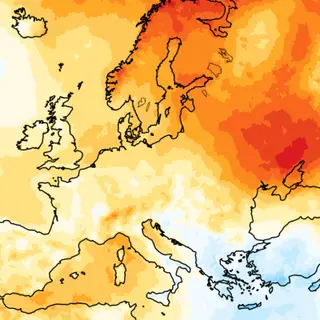
climate.copernicus.euSurface air temperature for October 2026October 2026 was the warmest October on record globally and the third consecutive month with temperatures more than 1.5°C above the pre-industrial level. The predicted annual global temperature for 2026 is also predicted to exceed 1.5°C. For Europe as a whole, it was the second-warmest October on re